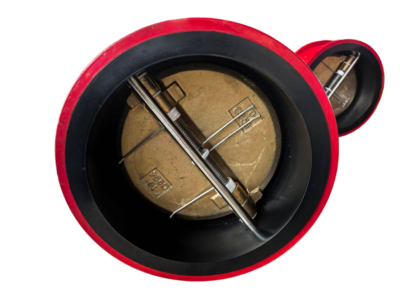
Rubber Seated Dual Plate Wafer Check Valve
Description
Dual Plate Wafer Check Valve Technical Data Sheet
Project Name: ________________________
Project No.: ________________________
Tag No.: ________________________
Date: ________________________
1. Valve General Information
| Parameter | Specification |
|---|---|
| Valve Type | Dual Plate Wafer Check Valve |
| Design Type | Wafer Type, Dual Plate (Tilting Disc) Design |
| Nominal Size (DN / NPS) | ______ mm / ______ inch |
| Pressure Rating (PN / Class) | ______ bar / ______ lb (e.g., PN10/16/25/40 or Class 150/300) |
| End Connection | Wafer Type (Clamped between pipeline flanges) |
| Face-to-Face Length | API 594 / ISO 5752 / EN 558 Series _____ mm (Or Manufacturer Standard) |
| Design Standard | API 594 / ASME B16.34 / EN 16767 |
| Test Standard | API 598 / ISO 5208 / EN 12266 |
2. Materials of Construction
| Component | Material |
|---|---|
| Body | ASTM A351 CF8M (316 Stainless Steel) or ASTM A182 F316(Forged) |
| Plates (Dual Discs) | ASTM A351 CF8M (316 Stainless Steel) or ASTM A182 F316 |
| Seal (Seat Ring) | Fluoroelastomer (FKM) – Broad chemical resistance, wide temperature range |
| Shaft / Hinge Pin | ASTM A276 316 / 316L Stainless Steel |
| Spring | 316 Stainless Steel (For quick closing action) |
| Stop Pin / Thrust Washer | 316 Stainless Steel |
| O-Rings / Auxiliary Seals | Fluoroelastomer (FKM) |
3. Design Features
| Feature | Description |
|---|---|
| Dual Plate Design | Two half-moon plates rotate around a central hinge pin. Provides low pressure drop, quick closing action, and reduced water hammer effect. |
| Wafer Type | Short face-to-face length, lightweight, and easy to install between two flanges, saving space and weight. |
| Soft Seal (FKM) | FKM elastomer seal between plates and body provides bubble-tight / zero leakage shut-off. FKM offers excellent resistance to high temperatures, oils, fuels, and many chemicals. |
| Spring-Assisted Closing | Internal stainless steel torsion springs ensure rapid plate closure upon flow reversal, preventing backflow before reverse flow is fully developed. |
| Blow-Out Proof Shaft | The hinge pin/shaft is designed to be blow-out proof, ensuring safety. |
| Installation Orientation | Suitable for horizontal or vertical lines (check spring torque suitability). |
4. FKM Seal Material Properties
| Property | Description |
|---|---|
| Temperature Range | Typically -20°C to +200°C (-4°F to +392°F) depending on compound |
| Media Compatibility | Resistant to mineral oils, fuels, aliphatic hydrocarbons, many acids, ozone, and aging. Not compatible with ketones, esters, brake fluids, and some organic solvents. |
| Sealing Class | Zero Leakage (Bubble-tight) per API 598 / ISO 5208 |
5. Applicable Standards & Specifications
| Item | Standard |
|---|---|
| Design & Manufacturing | API 594 / ASME B16.34 / EN 16767 |
| Face-to-Face Dimensions | API 594 / ISO 5752 / EN 558 |
| Flange Compatibility | Suitable for ASME B16.5 / EN 1092 / JIS flanges (valve clamped between flanges) |
| Pressure-Temperature Rating | ASME B16.34 or EN 12516 |
| Pressure Testing | API 598 / ISO 5208 / EN 12266 |
| Materials | ASTM Standards / EN Standards |
6. Pressure Test (API 598 / ISO 5208)
| Test Type | Pressure | Medium | Duration |
|---|---|---|---|
| Shell (Hydrostatic) | 1.5 x Rated Pressure | Water | As per standard |
| Seat Test (Low Pressure) | 5-6 bar / 80-90 psi | Air or Nitrogen | As per standard |
| Seat Test (High Pressure) | 1.1 x Rated Pressure | Water | As per standard |
7. Dimensions & Connections (Reference Only)
| Dimension | Value (mm) |
|---|---|
| Face-to-Face Length L | _____ (Per API 594 / Manufacturer Standard) |
| Body Outer Diameter D | _____ (Matches pipeline flange OD) |
| Bolt Circle Diameter | Matches pipeline flange |
| Number of Plates | 2 |
| Approx. Weight | _____ kg |
8. Other Requirements
| Item | Specification |
|---|---|
| Service Medium | Water, Oil, Gas, Chemicals (must be compatible with FKM) |
| Design Temperature | _____ °C (Within FKM limits) |
| Design Pressure | _____ bar(g) |
| Flow Direction | Unidirectional (Flow arrow marked on body) |
| Installation Position | Horizontal / Vertical (Check spring suitability for vertical installation) |
| Special Treatment | Degreasing / Oxygen cleaning if required |
Notes:
-
FKM (Fluoroelastomer) seats provide excellent sealing performance but media compatibility must be verified, especially with polar solvents.
-
Dual plate check valves are not recommended for highly pulsating flow conditions, as this can cause plate flutter and premature failure.
-
Ensure the flow direction arrow on the body matches the actual pipeline flow direction during installation.
-
Dimensions and pressure ratings must be confirmed based on the specific size and pressure class required.