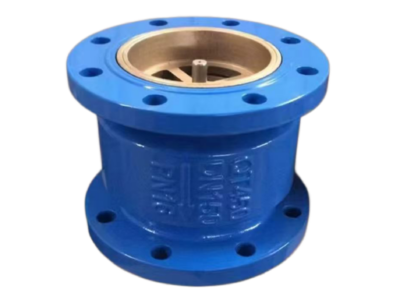
DN250-PN16 Wafer Dual Plate Check Valve
Description
Technical Data Sheet: DN250-PN16 Wafer Dual Plate Check Valve
| Item | Specification |
|---|---|
| Product Name | Wafer Dual Plate Check Valve / Wafer Double Door Check Valve |
| Type/Series | General Purpose (e.g., Series equivalent to Pegler V909, Oventrop, Honeywell Impact) |
| Nominal Diameter | DN250 (10 inches) |
| Nominal Pressure | PN16 |
| End Connection | Wafer Type Design, designed for installation between PN16 flanges (According to EN 1092-2, ISO 7005-2, or ASME B16.5 Class 150) |
| Design Structure | Dual Plate / Double Door with Spring-Loaded Hinge |
Technical Parameters
| Parameter | Value | Remarks |
|---|---|---|
| Pressure Rating | PN 16 / 16 bar | Maximum allowable working pressure |
| Shell Test Pressure | 24 bar | Hydrostatic test |
| Seat Test Pressure | 17.6 bar | Hydrostatic test |
| Suitable Media | Water, Non-corrosive liquids, HVAC water, Potable water | Not suitable for heavily polluted media or strong acids/bases unless specified |
| Medium Temp. Range | -10°C to +110°C (Standard) | Dependent on seat material |
| -29°C to +180°C (Special Seals) | ||
| Flow Coefficient (Kv) | Approx. 2000 – 2330 m³/h | Flow rate at ΔP = 1 bar, fully open |
| Installation Position | Horizontal or Vertical | For horizontal lines, hinge pin must be horizontal/vertical; For vertical lines, flow must be upwards |
| Flow Direction | Unidirectional | Must match arrow marking on body |
Materials of Construction
| Component | Material | Remarks / Alternative |
|---|---|---|
| Body | Ductile Iron / Cast Iron | e.g., EN-GJS-450-10 (GGG40), EN-GJL-250 |
| Discs / Plates | Stainless Steel / Coated Ductile Iron | Common: SS304, SS316; or Epoxy-coated Ductile Iron |
| Shaft / Pin | Stainless Steel | e.g., SS420, SS316 |
| Springs | Stainless Steel | |
| Seat / Seal | EPDM (Ethylene Propylene Diene Monomer) | Standard Option: Suitable for water, wastewater, mild chemicals |
| NBR (Nitrile Butadiene Rubber) | Suitable for oils and fuels | |
| PTFE (Polytetrafluoroethylene) | High temperature or corrosive media | |
| Coating | Epoxy / Anti-corrosion Paint | Standard color: Blue (RAL 5005) or as specified |
Face-to-Face & Installation Dimensions (mm)
The face-to-face dimension (L) is critical for correct installation between flanges.
| Dimension | Value | Standard / Reference |
|---|---|---|
| Face-to-Face Length (L) | 108 mm | According to EN 558-1 Series 49 (formerly DIN 3202 K3) |
| 114 mm | Alternative dimension depending on manufacturer design | |
| Body Diameter (D) | ~328 mm | Maximum outer diameter to fit between PN16 DN250 flanges |
| Reference: Flange Bolt Circle Dia. (K) | 355 mm | Corresponds to EN 1092-2 PN16 DN250 flange |
| Reference: Flange Bolt Holes | 12 – Ø26 mm | Corresponds to EN 1092-2 PN16 DN250 flange |
| Approx. Weight | ~19.5 kg | Range varies by manufacturer (approx. 13.8kg – 30kg) |
Dimensional Sketch (Reference Only):
      _______
  <-->|     |<--  L (Face-to-Face Length)
   |  |_____|  |
   |            |
   |   D (Body Diameter / Max. Width)  |
   |            |
   |____________|
      (Flow ↑)
Applicable Standards
-
Design & Manufacture: EN 16767, API 594, BS 5153, JB/T 8937
-
Face-to-Face: EN 558-1 (Series 49), ISO 5752, DIN 3202 K3
-
Flange Connection: EN 1092-2, ISO 7005-2, ASME B16.5 Class 150 (compatible)
-
Inspection & Testing: EN 12266, API 598, ISO 5208
Key Features & Applications
Key Features:
-
Compact & Lightweight: The wafer design saves space and reduces weight compared to swing check valves.
-
Quick Closing / Non-Slam: Short spring-assisted disc travel minimizes the risk of water hammer and prevents reverse flow effectively.
-
Low Pressure Drop: Streamlined body and disc design offer low resistance to flow.
-
Versatile Installation: Can be installed in both horizontal and vertical pipelines.
Main Applications:
-
Water Supply and Distribution
-
HVAC Systems (Heating, Ventilation, and Air Conditioning)
-
Industrial Cooling Water Circuits
-
Pump Protection (Preventing backflow damage)
Notes:
-
This datasheet is based on general industry specifications. For final installation, please refer to the official datasheet of the specific manufacturer (e.g., Flowserve, Bray, Emerson, KSB).
-
When ordering, please specify the required seat material (EPDM, NBR, PTFE, etc.) based on your media temperature and chemical compatibility.