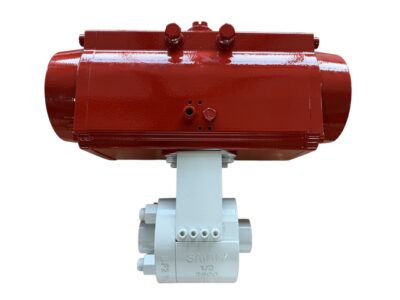
API 5000# – API 6A FLS Pattern Slab Gate Valve
Description
Technical Data Sheet – API 6A FLS Slab Gate Valve
1. Product Overview
-
Product Name: API 6A FLS Slab Gate Valve
-
Valve Type: Slab Gate Valve (Through-Conduit, Floating Gate Design)
-
Design Standard: API Specification 6A (21st Edition)
-
Size Range: 1-13/16″ to 11″ (46mm to 279mm)
-
Pressure Ratings: 2,000 psi to 20,000 psi (13.8 MPa to 138 MPa)
-
Body Material: Forged Alloy Steel (AISI 4130, 75 KSI Yield / 95 KSI Tensile)
-
Operation: Manual (Non-Rising Stem) / Hydraulic Actuator
-
Connection Type: Flanged End (API 6A Flange) / Clamp Hub / Threaded
-
Application: Wellhead Christmas Trees, Choke & Kill Manifolds, Fracturing Service, Subsea Production Systems
2. Applicable Standards & Specifications
| Item | Standard / Requirement |
|---|---|
| Design and Manufacture | API Spec 6A (21st Edition) – Monogrammed |
| Product Specification Level | PSL 1, 2, 3, 3G, 4 |
| Performance Requirement | PR1, PR2 (Qualified to API 6A Annex F) |
| Material Class | AA, BB, CC, DD, EE, FF, HH |
| Temperature Rating | K, L, P, R, S, T, U, V (-60°F to +350°F / -51°C to +177°C) |
| NACE Compliance | MR0175 / ISO 15156 (Sour Service) |
| Inspection and Testing | API 6A / API 598 |
| End Connections | API 6A Flanges / Clamp Hubs / Threaded |
3. Technical Parameters
| Parameter | Specification | |||||
|---|---|---|---|---|---|---|
| Nominal Bore Sizes | 1-13/16″, 2-1/16″, 2-9/16″, 3-1/16″, 4-1/16″, 5-1/8″, 7-1/16″, 9″, 11″ | |||||
| Working Pressure | 2,000 psi | 3,000 psi | 5,000 psi | 10,000 psi | 15,000 psi | 20,000 psi |
| Design Temperature Range | -60°F to +350°F (-51°C to +177°C) depending on temperature class | |||||
| Bore Type | Full Bore, Through-Conduit Design | |||||
| Stem Type | Non-Rising Stem (NRS) | |||||
| Sealing Principle | Metal-to-Metal, Bi-Directional | |||||
| Seat Design | Floating Slab Gate with Spring-Loaded Seats | |||||
| Stem Sealing | Non-Elastomeric, Spring-Loaded, Pressure-Energized Lip Seals | |||||
| Gate Design | Slab Gate (Parallel Sealing Surfaces) | |||||
| Body-to-Bonnet Seal | Metal-to-Metal (or optional CRA Inlay) | |||||
| Leakage Rate | API 6A / API 598 (Bubble Tight) |
4. Main Materials of Parts
| Part Name | Standard Material | Optional Materials / Notes |
|---|---|---|
| Body | AISI 4130 Forged Alloy Steel (75K yield) | Stainless Steel / CRA Clad for corrosive service |
| Bonnet | AISI 4130 Forged Alloy Steel | Stainless Steel / CRA Clad |
| Gate | 410 Stainless Steel + Tungsten Carbide (TC) Coating | Inconel 625 / Hardfaced |
| Seats | 410 Stainless Steel + TC Coating | Inconel 625 with Hardfacing |
| Stem | 410 Stainless Steel + QPQ Treatment | 17-4 PH / Inconel 718 |
| Body-to-Bonnet Seals | Metal Ring Gasket (RX/BX) | Alloy 625 Inlaid Ring Grooves |
| Seat Seals | Non-Elastomeric Lip Seals (Spring-Loaded) | Pressure-Energized Metal Seals |
| Stem Seals | Non-Elastomeric Lip Seals (Spring-Loaded, Pressure-Energized) | PTFE / Graphite Backup |
| Bolting | API 20E, BSL 2 (Alloy Steel) | Stainless Steel / Inconel |
| Bearings | Anti-Friction Bearings with Grease Fitting | — |
| Operator / Handwheel | Cast Iron / Fabricated Steel | Gear Operator (optional) |
5. Design Features
5.1 Valve Design
-
Slab Gate Construction: Parallel gate design with floating seats provides bi-directional sealing and allows thermal expansion .
-
Through-Conduit Full Bore: Full bore design eliminates pressure drop and turbulence, allowing passage of pigs and tools .
-
Forged Construction: All pressure-containing parts are forged for superior strength and reliability in high-pressure service .
5.2 Sealing System
-
Metal-to-Metal Sealing: Gate-to-seat, seat-to-body, and body-to-bonnet seals are metal-to-metal, ensuring fire-safe performance .
-
Dual Lip Seat Seals: Two spring-loaded, pressure-energized non-elastomeric lip seals between each seat:
-
Serve as barrier against contaminants
-
Maintain gate-to-seat contact, eliminating body cavity clearance
-
Enhance sealing at very low differential pressures
-
-
Stem Backseat: Provides secondary stem seal and allows packing replacement under pressure when valve is fully open .
-
Non-Elastomeric Stem Seal: Spring-loaded, pressure-energized design requires no longitudinal preload or precise spaceout .
5.3 Operational Features
-
Bi-Directional Sealing: Seals pressure from either direction equally .
-
Non-Rising Stem (NRS): Ideal for limited space installations; stem threads protected from environment .
-
Low Operating Torque: Anti-friction bearings and optimized seat design reduce torque requirements .
-
Bearing Lubrication: Grease fitting allows positive bearing lubrication .
-
Optional Torque Multiplier: Available for high-pressure manual operation .
5.4 Additional Features
-
Qualification Testing: Certified to API 6A Annex F (PR-2) and Annex I (Class II) for extreme service .
-
CRA Inlay: Optional Alloy 625 inlay on ring grooves for corrosion resistance .
-
Actuator Ready: Easily equipped with hydraulic actuators for manifold or subsea service .
-
Sealant Injection: Optional emergency sealant injection fittings for seats and stem .
6. Dimensional Data (Typical – Flanged End)
Note: Dimensions are for reference only. Final dimensions depend on pressure class, manufacturer, and specific configuration.
| Bore Size (inches) | Working Pressure (psi) | Face-to-Face L (mm) | Overall Height H (mm) | Flange OD (mm) | Approx. Weight (kg) | Reference |
|---|---|---|---|---|---|---|
| 1-13/16″ | 10,000 | 418 | 463 | 144 | 108 | |
| 1-13/16″ | 15,000 | 425 | 457 | 149 | 136 | |
| 2-1/16″ | 10,000 | 417 | 520 | 144 | 120 | |
| 2-1/16″ | 15,000 | 425 | 482 | 149 | 149 | |
| 2-9/16″ | 10,000 | 448 | 565 | 171 | 167 | |
| 2-9/16″ | 15,000 | 481 | 533 | 196 | 204 | |
| 3-1/16″ | 10,000 | 471 | 619 | 206 | 235 | |
| 3-1/16″ | 15,000 | 578 | 598 | 245 | 399 | |
| 4-1/16″ | 10,000 | 544 | 670 | 258 | 385 | |
| 4-1/16″ | 15,000 | 636 | 736 | 297 | 616 |
For complete dimensional data across all sizes and pressure classes, refer to manufacturer’s certified drawings.
7. Available Configurations – Size vs. Pressure Matrix
| Bore Size (in) | 2,000 psi | 3,000 psi | 5,000 psi | 10,000 psi | 15,000 psi | 20,000 psi | 30,000 psi |
|---|---|---|---|---|---|---|---|
| 1-13/16″ | — | — | — | FLS | FLS | FLS | FLS |
| 2-1/16″ | FL/FLS | FL/FLS | FL/FLS | FLS | FLS | FLS | — |
| 2-9/16″ | FL/FLS | FL/FLS | FL/FLS | FLS | FLS | FLS | FLS |
| 3-1/16″ | — | — | — | FLS | FLS | FLS | — |
| 3-1/8″ | FL/FLS | FL/FLS | FL/FLS | — | — | — | — |
| 4-1/16″ | — | — | — | FLS | FLS | FLS | — |
| 4-1/8″ | FL/FLS | FL/FLS | FL/FLS | — | — | — | — |
| 5-1/8″ | FLS | FLS | FLS | FLS | FLS | — | — |
| 6-3/8″ | FLS | FLS | FLS | FLS | FLS | — | — |
| 7-1/16″ | — | — | FLS | FLS | FLS | — | — |
| 9″ | — | — | FLS | FLS | FLS | — | — |
| 11″ | — | — | FLS | — | — | — | — |
8. Material & Specification Options
| Parameter | Available Options |
|---|---|
| Material Class | AA (General), BB (Mild Corrosion), CC (Moderate Corrosion), DD (Sour Service-NL), EE (Sour Service), FF (Sour Service), HH (Severe Sour Service) |
| Temperature Class | K (-60 to 180°F), L (-20 to 250°F), P (-20 to 350°F), R (RT), S (-20 to 150°F), T (-20 to 200°F), U (0 to 250°F), V (35 to 350°F) |
| PSL Level | PSL1 (Standard), PSL2 (Enhanced), PSL3 (Critical), PSL3G (Sour/Gas), PSL4 (Extreme) |
| PR Level | PR1 (Standard), PR2 (Enhanced – qualified to Annex F) |
| NACE Compliance | MR0175 / ISO 15156 (Sour Service) |
| Gate/Seat Coating | Tungsten Carbide (TC), Chrome Carbide, Inconel Cladding |
| End Connections | Flanged (6B/6BX), Clamp Hub, Threaded |
9. Inspection & Testing
| Test Type | Criteria / Standard |
|---|---|
| Shell Test | Hydrostatic at 1.5 × rated working pressure per API 6A |
| Seat Test | Hydrostatic at 1.1 × rated working pressure (both seats independently) |
| Backseat Test | Hydrostatic at rated working pressure |
| Low Pressure Seat Test | Pneumatic at 50-100 psi (optional) |
| PR2 Qualification | Temperature cycling, pressure cycling, gas test per API 6A Annex F |
| Material Certification | EN 10204 3.1 / 3.2 available |
| NACE Compliance | Hardness testing per MR0175 requirements |
| PMI Testing | Positive Material Identification available |
| NDE | MPI, UT, RT per PSL requirements |
10. Applications
| Industry | Typical Services |
|---|---|
| Oil & Gas Production | Wellhead Christmas Trees, Production Manifolds |
| Drilling Operations | Choke & Kill Manifolds, Mud Manifolds |
| Well Intervention | Fracturing Service, Stimulation |
| Subsea Production | Subsea Trees, Manifolds |
| Pipeline | High-Pressure Isolation |
| Refining/Petrochemical | Severe Service Isolation |
Remarks:
-
The FLS valve is suitable for extreme sour service (HH material class) with proper material selection .
-
For subsea applications, additional features such as ROV interface and double block-and-bleed are available.
-
Hydraulic actuators (fail-safe close/open) can be integrated for remote operation .
This data sheet is for reference only. All specifications are subject to final confirmation by the manufacturer based on specific service conditions and applicable API 6A requirements.