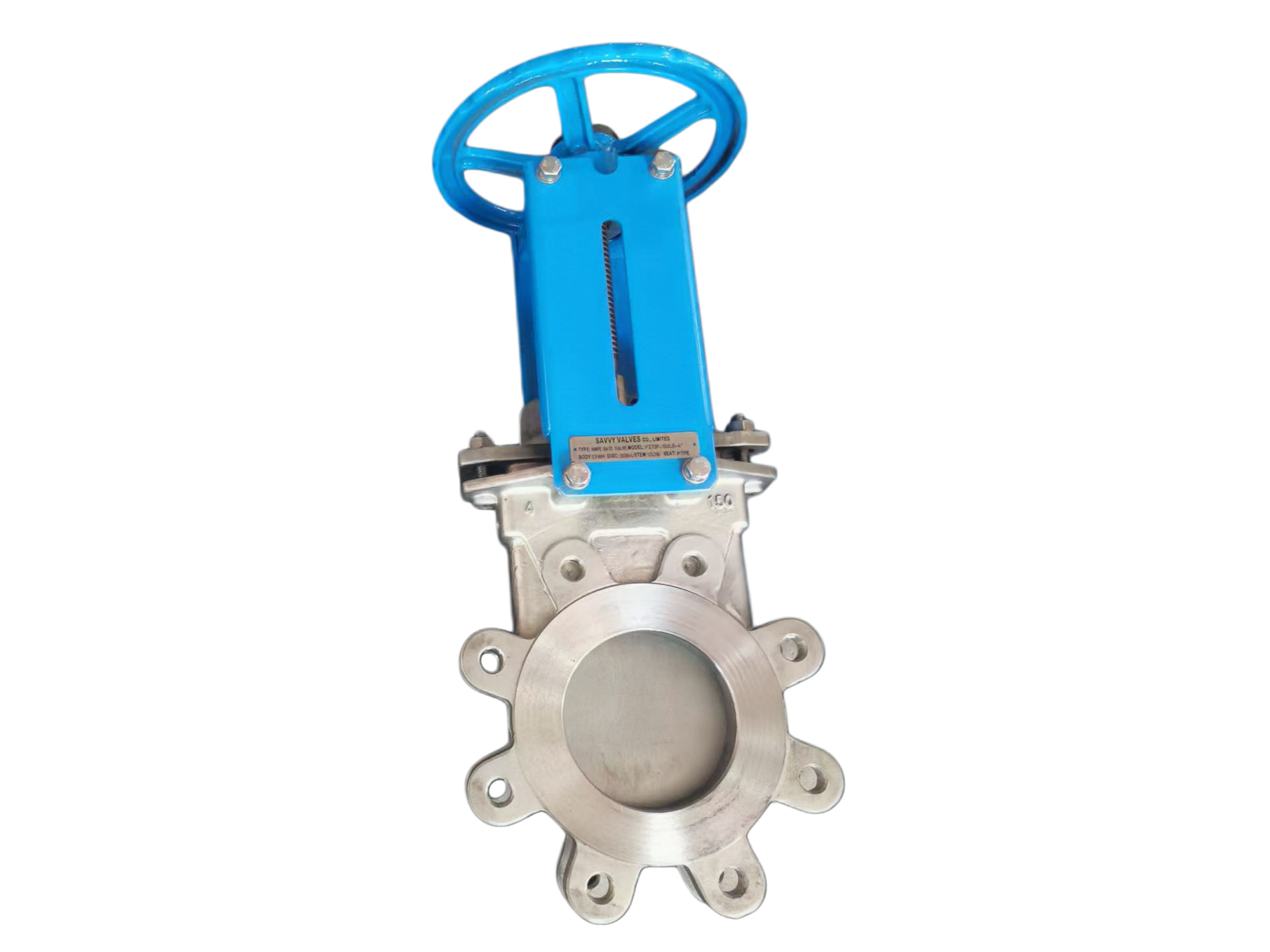
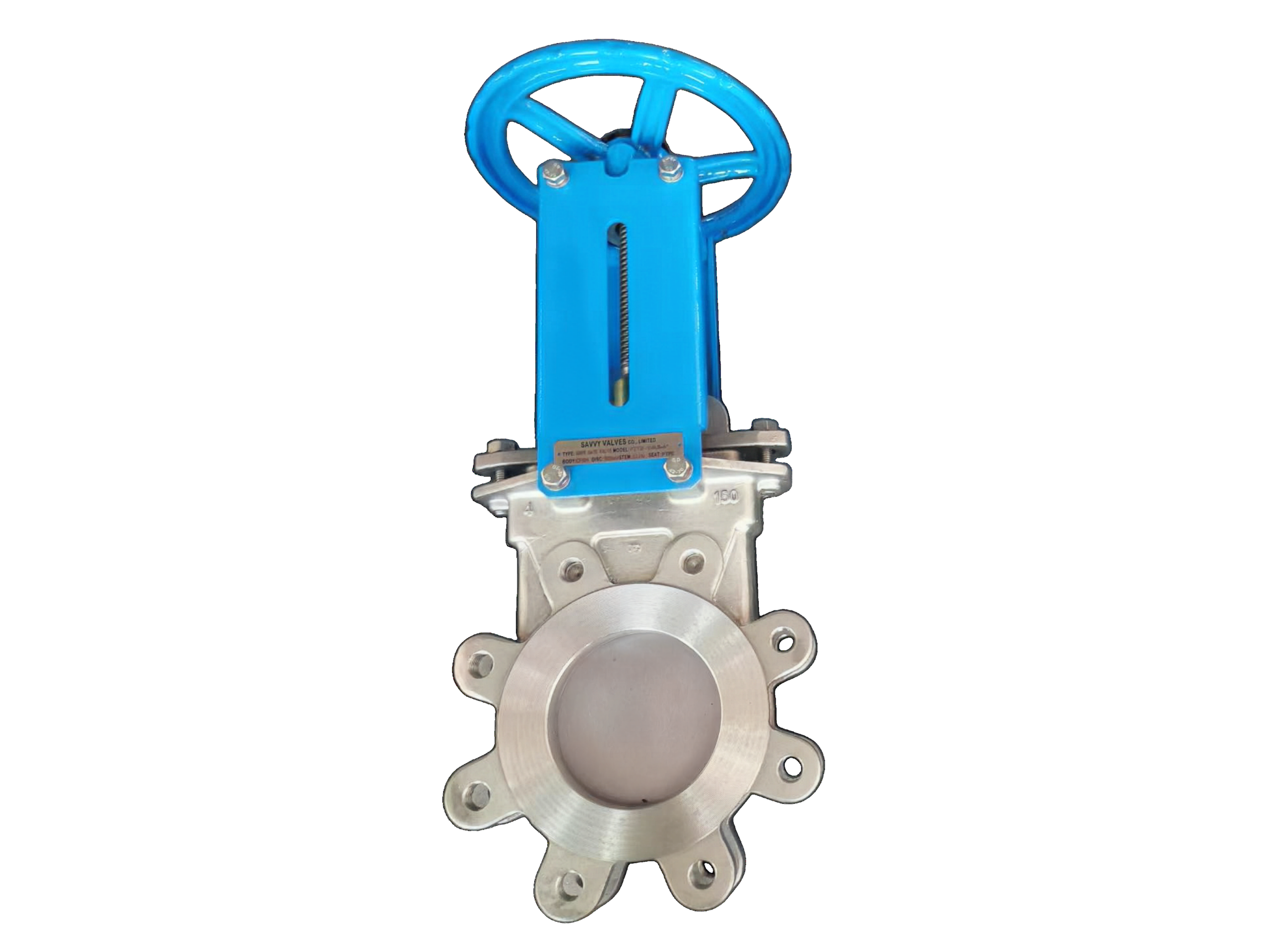


8″-150LB-Lugged 316SS Knife Gate Valve
Description
8″-150LB-Lugged 316SS Knife Gate Valve – Technical Data Sheet
1. General Description
Product Name: Lugged Type Knife Gate Valve
Model: 8″-150LB-Lugged 316SS
Nominal Diameter: 8 inches (NPS 8, DN 200)
Pressure Class: Class 150 (ANSI 150LB)
Connection Type: Lugged type – body features threaded lugs on both sides; bolts pass through flange holes and thread directly into the body, eliminating the need for through-bolts, suitable for dead-end service or single-side dismantling
Body Material: 316 Stainless Steel (ASTM A351 Grade CF8M)
Product Introduction:
The knife gate valve is a shut-off valve specifically designed for slurries, granular materials and fibrous media. Its key closure member is a gate with a sharp knife edge. When fully open, the gate is completely lifted above the valve body, allowing the medium to pass straight through with a smooth, unobstructed flow path, minimizing sediment accumulation. During closing, the sharp lower edge of the gate easily cuts through solid particles and fibrous debris in the flow channel, ensuring a tight shut-off. The 8″-150LB-Lugged 316SS knife gate valve features a lugged body design that facilitates installation and removal of downstream piping without system depressurization. It is suitable for low to medium pressure applications and is widely used in chemical, pulp and paper, wastewater treatment, mining, and corrosive fluid handling industries.
2. Design Standards
| Item | Standard |
|---|---|
| Design & Manufacture | MSS SP-81 / ASME B16.34 |
| Face-to-Face (Structure Length) | MSS SP-81 (short pattern) |
| Flange Connection Dimensions | Body drilled to match ASME B16.5 Class 150 / PN10 / PN16 flanges |
| Inspection & Testing | API 598 / MSS SP-81 |
| Materials | ASTM Standards |
| Marking | MSS SP-25 |
MSS SP-81 applies to stainless-steel or stainless-steel-lined, bonnetless, knife gate valves with flanged ends for sizes NPS 2 (DN 50) through NPS 36 (DN 900).
3. Main Technical Parameters
| Parameter | Value |
|---|---|
| Nominal Pipe Size (NPS) | 8″ (DN 200) |
| Pressure Class | Class 150 (150 LB) |
| Maximum Working Pressure | 150 psi (10.3 bar) |
| Face-to-Face Dimension L | 7″ (approx. 178 mm)* |
| Approx. Open Height (Fully Open) | 33″ (approx. 838 mm) |
| Approx. Handwheel Diameter | 14″ (approx. 356 mm) |
| Approx. Weight | 112 lb (approx. 51 kg) |
| Flange Standard | ASME B16.5 Class 150 / PN10 / PN16 |
| Flange Facing | RF (Raised Face) / FF (Flat Face) |
| Connection Type | Lugged – tapped bolt holes |
| Actuation | Manual (handwheel) / Bevel gear / Pneumatic / Electric |
| Temperature Range | -29°C to +425°C (-20°F to +797°F) (depending on seat material) |
| Applicable Media | Slurries, pulp & paper stock, wastewater, chemical fluids, corrosive fluids, mining slurries |
| Valve Type | Bonnetless, rising stem |
*Note: Face-to-face dimensions per MSS SP-81 short pattern. The values listed above are typical. Actual dimensions may vary by manufacturer. Lugged bodies may have slightly longer face-to-face dimensions; confirm with manufacturer.*
4. Dimensional Data (Reference for 8″ Class 150 Lugged Knife Gate Valve)
| NPS | DN (mm) | Face-to-Face L (mm) | Height H (Open) (mm) | Handwheel Dia. (mm) | Bolt Circle Dia. (mm) | No. of Holes | Tapped Hole Depth (mm) | Approx. Weight (kg) |
|---|---|---|---|---|---|---|---|---|
| 8″ | 200 | 178 | 838 | 356 | 190.5 | 8 | 20 | 51 |
Note: Dimensional data for reference only. Flange drilling per ASME B16.5 Class 150. Tapped holes are typically UNC or metric threads; specify when ordering.
5. Main Component Materials (316SS Construction)
| Component | Material | Material Specification |
|---|---|---|
| Body | 316 Stainless Steel | ASTM A351 Grade CF8M (or CF3M for 316L) |
| Gate (Blade) | 316 Stainless Steel | ASTM A240 Type 316/316L, ground finish, beveled (sharpened) edge |
| Seat | PTFE (Virgin or Reinforced) / Metal-to-Metal / Resilient Liner (PU, EPDM) | Chemically inert, low friction, provides bubble-tight shut-off |
| Stem | 316 Stainless Steel | ASTM A276 Type 316, anti-blowout shoulder design, rolled threads |
| Packing | PTFE / Flexible Graphite / Braided Graphite | Chevron / V-ring type, adjustable |
| Packing Gland | 316 Stainless Steel | ASTM A351 CF8M |
| Yoke | Stainless Steel / Ductile Iron | Cast or fabricated |
| Bolting / Nuts | 316 Stainless Steel | ASTM A193 Grade B8M / A194 Grade 8M |
| Handwheel | Cast Iron / Carbon Steel + Coating / Stainless Steel | With stainless steel stem nut |
| Nameplate | Stainless Steel | Per MSS SP-25 marking |
Material Notes:
-
Body material: ASTM A351 CF8M (316 SS) provides excellent corrosion resistance in acidic, chloride, and industrial environments, suitable for food, chemical, and marine applications.
-
Seat material: PTFE seat is chemically inert, has low friction, and provides bubble-tight shut-off even with entrained solids. Resilient seats (EPDM, NBR, polyurethane) are available for slurry media.
-
Gate material: 316 SS gate has a ground finish to reduce friction against the seat; the beveled edge cuts through slurry solids.
6. Structural Features & Design Advantages
| No. | Feature | Description |
|---|---|---|
| 1 | Lugged Construction | Body features threaded lugs on both sides. Bolts pass through flange holes and thread directly into the body, eliminating the need for through-bolts. Suitable for dead-end service or single-side dismantling |
| 2 | Bidirectional Shut-Off | PTFE or resilient seat provides tight sealing in both directions |
| 3 | Knife-Edge Gate | Gate has a sharpened bottom edge that cuts through fibrous materials and solid particles in slurries, ensuring tight shut-off |
| 4 | Bonnetless Design | Thin wafer body minimizes media buildup. The gate lifts completely above the body when open |
| 5 | Full Port | Unrestricted flow path for low pressure drop. Self-cleaning – the gate cuts through sediment during closure |
| 6 | Anti-Blowout Stem | Stem is retained by an internal shoulder, cannot be ejected under pressure |
| 7 | Replaceable Seat | Seat can be replaced without removing the valve from the line (in most designs) |
| 8 | Self-Adjusting Packing | Adjustable packing gland provides effective stem sealing while also cleaning the gate |
| 9 | Flange Drilling | Drilled per ASME B16.5 Class 150, compatible with PN10/PN16 flanges |
7. Performance Data (Per API 598 / MSS SP-81)
| Test Type | Test Pressure | Medium | Acceptance Criteria |
|---|---|---|---|
| Shell (Hydrostatic) Strength Test | 1.5 × rated pressure (225 psi) | Water | No visible leakage |
| High-Pressure Seat Test | 1.1 × rated pressure (165 psi) | Water | No visible leakage |
| Low-Pressure Seat Test | 80-90 psi (5-6 bar) | Air or Nitrogen | Bubble-tight per API 598 |
Leakage Class:
-
PTFE / Resilient seats (EPDM/NBR/PU): Bubble-tight shut-off (zero leakage)
-
Metal hard seat: ANSI/FCI 70-2 Class III or Class IV
*Pressure test procedures and acceptance criteria in accordance with API 598 / MSS SP-81.*
8. Applications & Industries
| Industry | Typical Media | Remarks |
|---|---|---|
| Chemical Industry | Corrosive fluids, acids, chemical slurries | 316 SS body provides excellent corrosion resistance |
| Pulp & Paper | Pulp stock, black liquor, white water, paper slurry | Knife edge cuts through fibrous materials |
| Wastewater Treatment | Raw sewage, sludge, effluent | Handles fibrous and solid-laden wastewater |
| Mining / Metallurgy | Ore slurry, tailings, mineral concentrates | Wear-resistant, suitable for abrasive slurries |
| Food Industry | Food slurries, syrups, sauces | 316 SS provides sanitary, corrosion-resistant service |
| Marine Applications | Seawater, brackish water | 316 SS resists chloride-induced corrosion |
9. Actuation Options
| Actuation | Description | Typical Application |
|---|---|---|
| Manual (Handwheel) | Rising stem handwheel, low torque, easy operation; clockwise to close, counter-clockwise to open | General service, no automation |
| Manual (Bevel Gear) | Gear-operated for larger sizes or higher torque requirements | 8″ and larger sizes, hard-to-operate applications |
| Pneumatic Actuator | Double-acting or spring-return, fast stroke | Automated lines, explosion-proof areas |
| Electric Actuator | Remote control capability | Centralized control, intelligent systems |
| Electro-hydraulic Actuator | Smooth operation, low impact | High-pressure service, precise positioning |
10. Installation & Maintenance Instructions
-
Installation direction: For uni-directional valves, follow the flow arrow on the body. Bi-directional valves have no orientation restriction.
-
Lugged connection: Bolts pass through flange holes and thread directly into the body lugs. Do not use nuts on the opposite side (unless specified).
-
Dead-end service: Lugged design is suitable for end-of-line or isolation applications, allowing removal of downstream piping without depressurizing the system.
-
Flange alignment: Ensure the pipe flanges are precisely aligned to avoid uneven loading and leakage.
-
Bolting: Tighten bolts diagonally and evenly to the recommended torque values.
-
Packing maintenance: If packing leaks, tighten the packing gland bolts. Replace packing if worn out.
-
Seat maintenance: Clean the sealing area or replace the seat if damaged or contaminated.
-
Not for throttling: Knife gate valves are designed for fully open or fully closed service only – not for flow regulation.
-
Regular lubrication: Lubricate the actuation mechanism and stem periodically to ensure smooth operation.
11. Quality Assurance & Inspection
| Inspection Item | Details |
|---|---|
| Shell (Strength) Test | 100% at 1.5× rated pressure, no visible leakage per API 598 / MSS SP-81 |
| Seat Leakage Test | 100% at 1.1× rated pressure, leakage meets API 598 requirements |
| Low-Pressure Seat Test | 100% with air or nitrogen, bubble-tight |
| Material Verification | Material certificate provided (EN 10204 3.1 or 3.2) |
| Visual Inspection | 100% – no defects, uniform coating |
| Dimensional Check | 100% inspection per drawing |
| Functional Test | Smooth opening/closing, no sticking or binding |
| Marking Verification | Per MSS SP-25 |
*All tests are performed in accordance with API 598 and MSS SP-81.*


