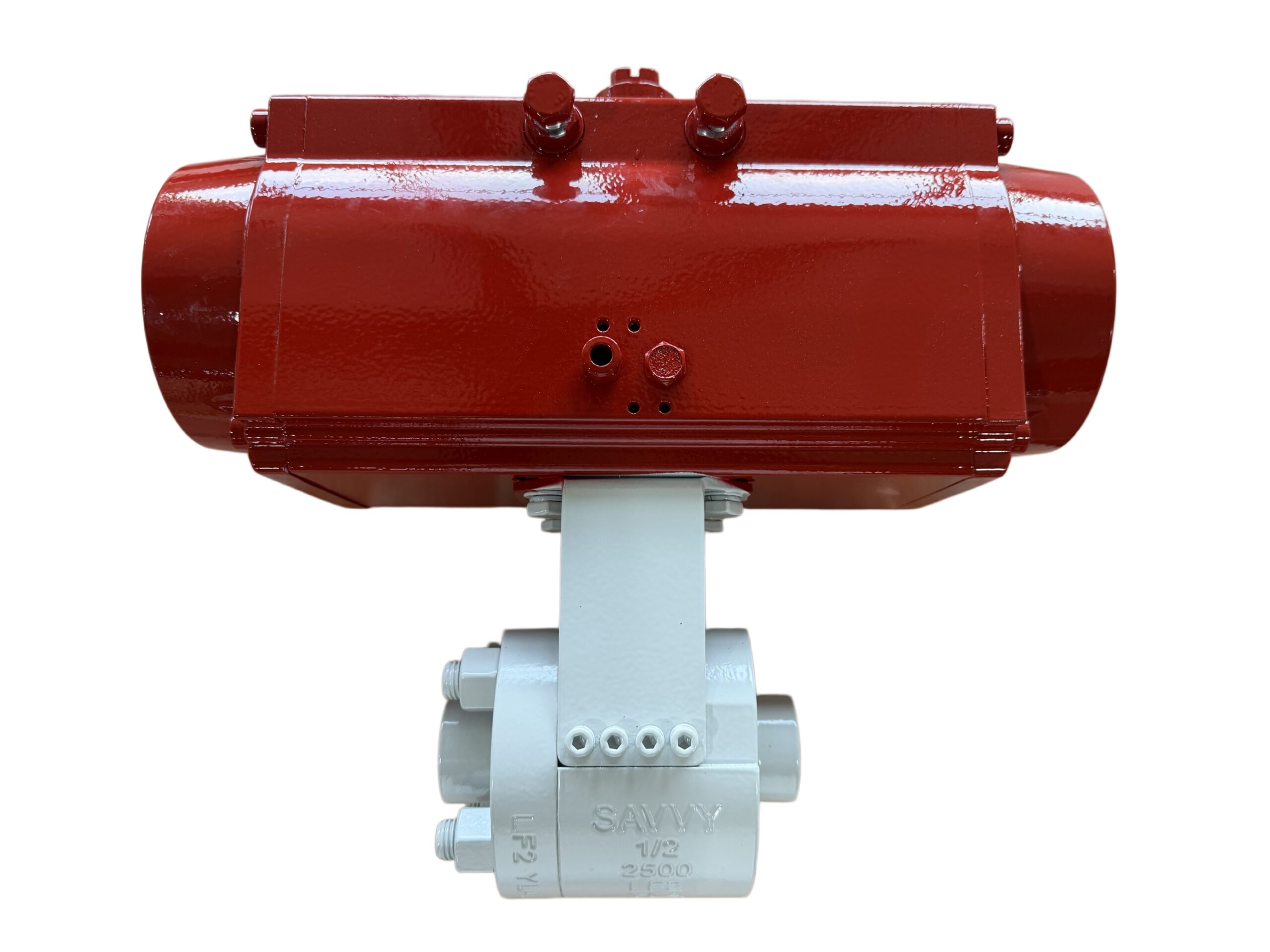
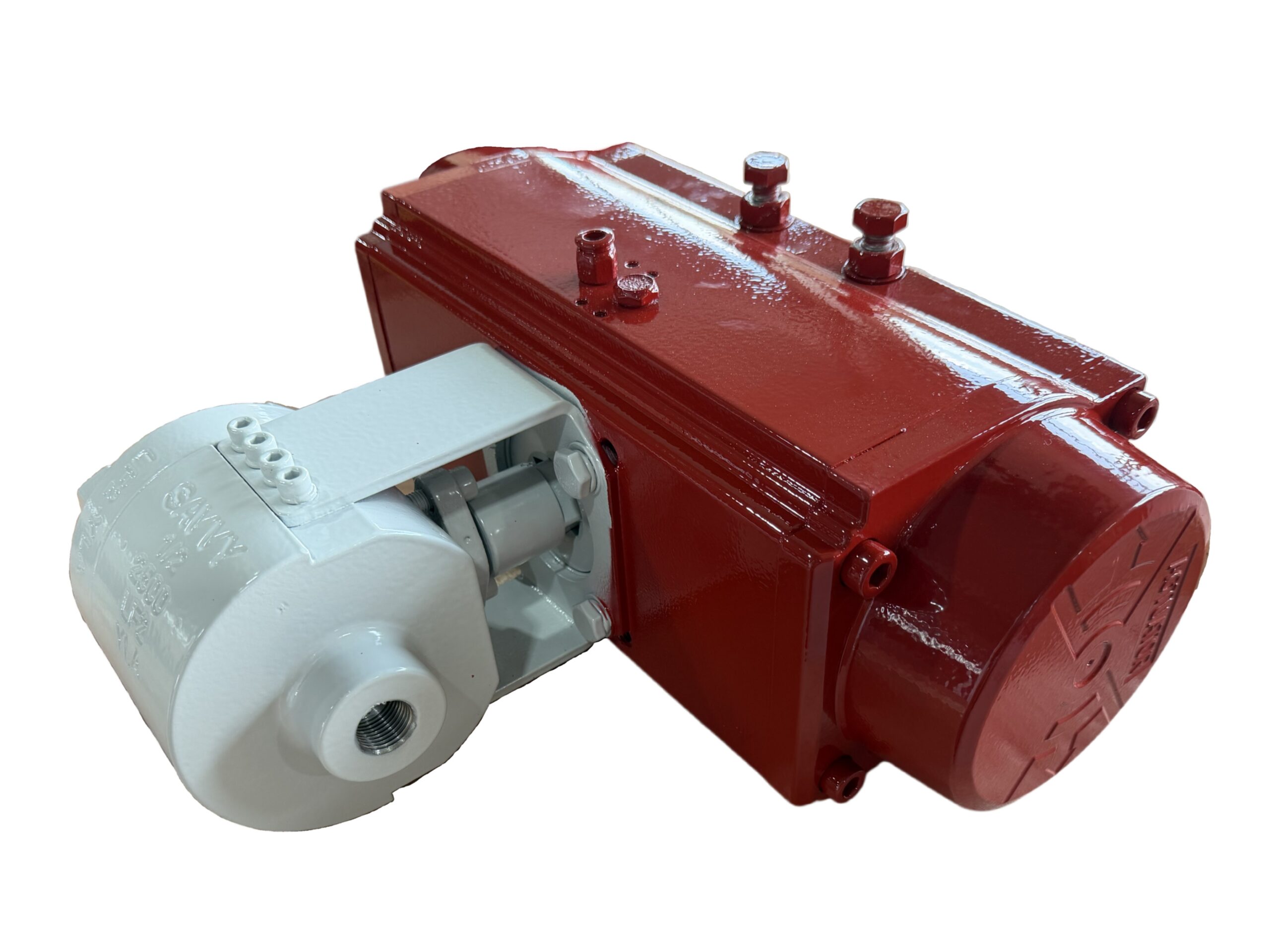
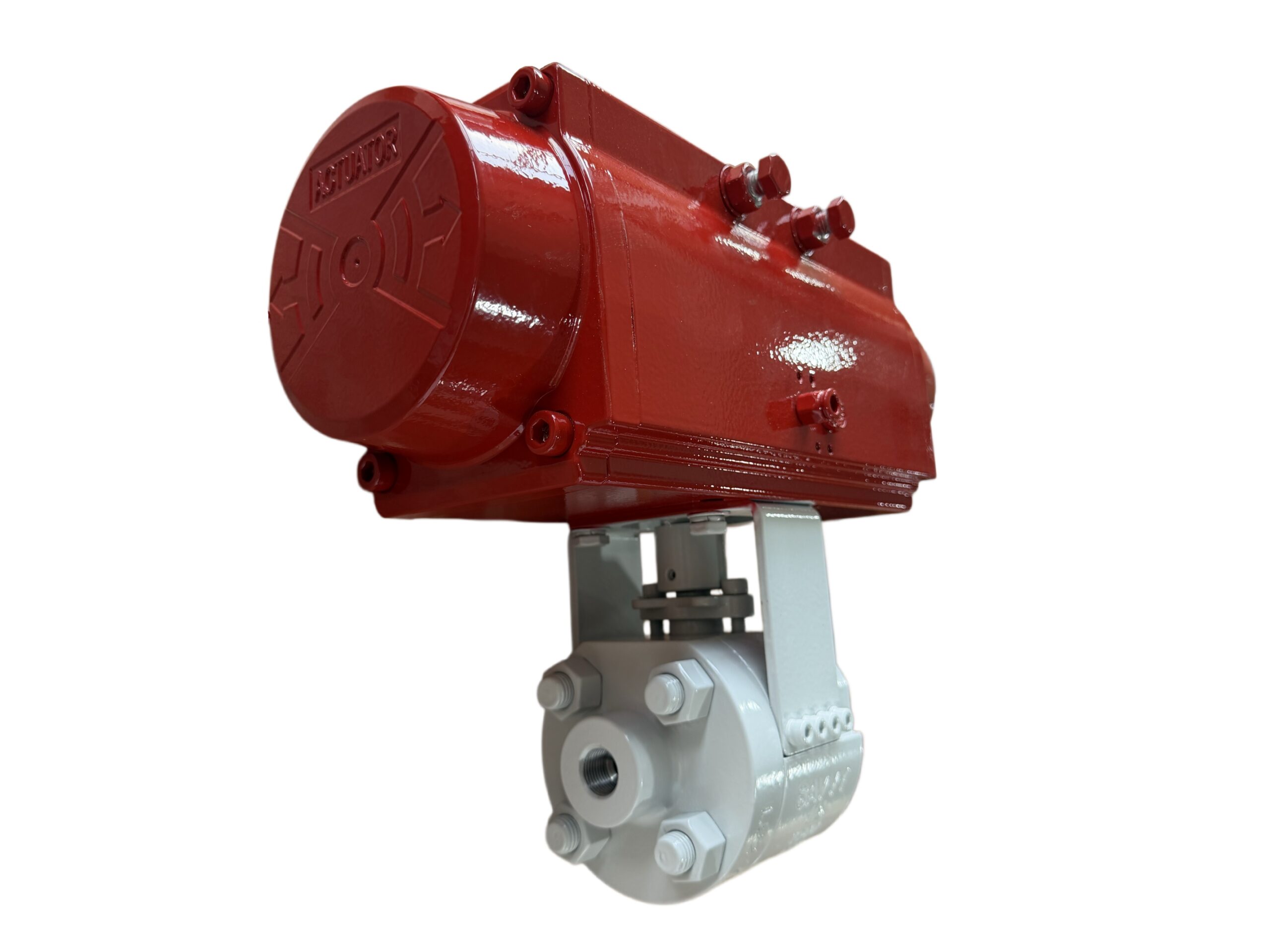
ESD Floating Ball Valve-1/2″ 2500LB BSPP
Description
ESD Floating Ball Valve – Technical Data Sheet
1. Product Overview
The ESD (Emergency Shutdown) Floating Ball Valve is a critical safety device designed for instant isolation of pipelines during emergency conditions. This valve features a floating ball design where the ball is displaced under medium pressure to seal against the downstream seat, ensuring bubble-tight shut-off. Equipped with a single-acting pneumatic actuator with spring return, the valve provides fail-safe operation – automatically closing upon loss of air supply or detection of abnormal conditions such as overpressure, fire, or system failure.
2. Valve Specifications
| Parameter | Specification |
|---|---|
| Valve Type | Floating Ball Valve – ESD (Emergency Shutdown) |
| Nominal Size | 1/2″ (DN15) |
| Pressure Rating | Class 2500 LB (PN420) |
| End Connection | BSPP (British Standard Pipe Parallel) female threaded |
| Operation | Single-acting pneumatic actuator, spring return (fail-safe) |
| Body Material | ASTM A350 LF2 (Low-Temperature Carbon Steel) |
| Trim Material | F51 Duplex Stainless Steel (ASTM A182 F51 / UNS S31803) |
| Seat Material | PEEK (Polyether Ether Ketone) |
| Design Standard | API 608 / API 6D / ASME B16.34 |
| Fire-Safe Design | API 607 / API 6FA |
3. Technical Parameters
3.1 Pressure-Temperature Ratings
| Parameter | Value |
|---|---|
| Nominal Pressure | Class 2500 LB (PN420) |
| Shell Test Pressure | 1.5 × rated pressure |
| Seal Test Pressure | 1.1 × rated pressure |
| Low-Pressure Seal Test | 0.6 MPa |
3.2 Temperature Range
| Component | Temperature Range |
|---|---|
| Body (LF2) | -46°C to +200°C |
| PEEK Seat | -100°C to +260°C (continuous use) |
| Valve Assembly | -29°C to +180°C (typical) |
Note: PEEK has a melting point of 334°C and glass transition temperature of 143°C; 30% glass or carbon fibre reinforced PEEK can withstand up to 316°C.
3.3 Flow Characteristics
| Parameter | Value |
|---|---|
| Valve Action | Quarter-turn (90° rotation) |
| Flow Pattern | Full bore or reduced bore (as specified) |
| Flow Resistance | Minimum (lowest of all valve types) |
| Shut-off | Bubble-tight, bi-directional sealing |
4. Materials of Construction
4.1 Standard Material Configuration
| Part | Material | Specification |
|---|---|---|
| Body | Low-Temperature Carbon Steel | ASTM A350 LF2 |
| Ball | Duplex Stainless Steel | ASTM A182 F51 (UNS S31803) |
| Stem | Duplex Stainless Steel | ASTM A182 F51 |
| Seat | PEEK (Polyether Ether Ketone) | Soft seat |
| Seals / Packing | PTFE / Graphite | As per design |
4.2 Material Properties
ASTM A350 LF2 (Body):
-
Forged low-temperature carbon steel
-
Excellent impact toughness at low temperatures
-
Widely used for low-temperature and high-pressure services
ASTM A182 F51 (Trim – Ball & Stem):
-
Duplex stainless steel (UNS S31803)
-
Mixed microstructure of austenite and ferrite
-
Superior strength over ferritic and austenitic grades
-
Excellent corrosion resistance
PEEK (Seat):
-
High-performance engineering thermoplastic
-
Continuous use temperature: 260°C
-
Excellent chemical resistance
-
High mechanical strength and wear resistance
-
Suitable for high-pressure applications up to Class 2500 LB
5. Actuator Specifications
5.1 Pneumatic Actuator – Single Acting, Spring Return
| Parameter | Specification |
|---|---|
| Actuator Type | Single-acting pneumatic actuator |
| Fail-Safe Mode | Spring return (fail-close or fail-open as configured) |
| Operation | Air pressure moves ball to one position; spring returns upon air loss |
| Supply Pressure | As per actuator sizing (typically 4–8 bar) |
| Mounting | ISO 5211 top flange |
| Accessories | Limit switches, solenoid valve, positioner (optional) |
5.2 Actuator Operating Principle
-
Single-acting (Spring Return): Compressed air is required to operate the valve in one direction. Upon loss of air pressure, the stored energy in the springs forces the piston to return the valve to its fail-safe position.
-
ESD Function: Supports remote ESD signals (hardwired/wireless), accepting commands from station control systems or leak detection systems for emergency safety shutdown.
6. Design Features
| Feature | Description |
|---|---|
| Floating Ball Design | Ball is displaced by medium pressure against downstream seat for positive sealing |
| Fire-Safe Design | Complies with API 607 / API 6FA |
| Anti-Static Device | Stem-to-ball and stem-to-body anti-static spring |
| Blow-Out Proof Stem | T-shaped lower end prevents stem ejection under pressure |
| Low Emission Design | Live-loaded stem packing for fugitive emission control |
| ISO Mounting Pad | ISO 5211 top flange for easy actuator mounting |
| Locking Device | Optional locking device available |
| Bi-Directional Seal | Seals in both flow directions |
7. Applicable Standards
| Standard | Description |
|---|---|
| API 608 | Metal Ball Valves – Flanged, Threaded, and Welding Ends |
| API 6D | Pipeline and Piping Valves |
| ASME B16.34 | Valves – Flanged, Threaded, and Welding End |
| ASME B16.10 | Face-to-Face and End-to-End Dimensions |
| ASME B16.5 | Pipe Flanges and Flanged Fittings |
| API 607 / API 6FA | Fire Test for Soft-Seated Quarter-Turn Valves |
| API 598 | Valve Inspection and Testing |
| ISO 15848 | Fugitive Emissions (optional) |
8. Inspection & Testing
| Test | Standard |
|---|---|
| Shell Strength Test | 1.5 × rated pressure |
| High-Pressure Seal Test | 1.1 × rated pressure |
| Low-Pressure Seal Test | 0.6 MPa |
| Fire-Safe Test | API 607 / API 6FA |
| Fugitive Emission Test | ISO 15848 (optional) |
9. Application & Service Conditions
| Parameter | Specification |
|---|---|
| Primary Function | Emergency Shutdown (ESD) / Safety isolation |
| Typical Applications | Oil & gas pipelines, petrochemical, chemical, power plants, offshore platforms |
| Service Media | Natural gas, oil, petrochemicals, water, corrosive media (acids, alkalis) |
| Actuation Mode | Pneumatic – single acting with spring return |
10. Ordering Information
When ordering, please specify:
| Item | Specification |
|---|---|
| Valve Type | ESD Floating Ball Valve |
| Size | 1/2″ |
| Pressure Rating | Class 2500 LB |
| End Connection | BSPP female thread |
| Body Material | ASTM A350 LF2 |
| Trim Material | ASTM A182 F51 |
| Seat Material | PEEK |
| Actuator | Single-acting pneumatic, spring return |
| Accessories | As required (limit switches, solenoid valve, etc.) |
| Special Requirements | Fire-safe, anti-static, low emission, etc. |


