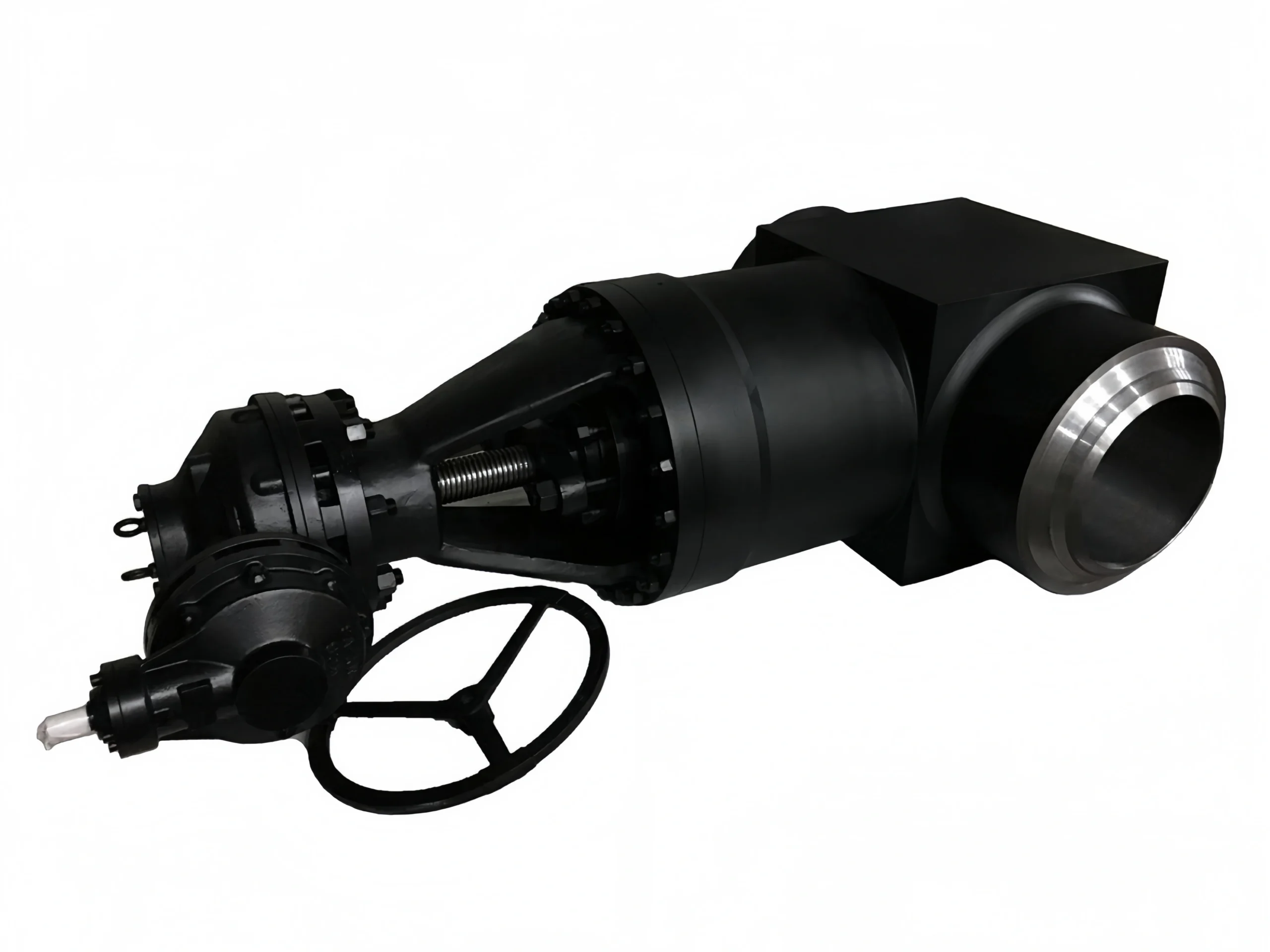

16″ (DN400) Class 1500 Forged Parallel Slide Gate Valve
Description
Technical Data Sheet: 16″ (DN400) Class 1500 Forged Parallel Slide Gate Valve
1. General Description
This data sheet covers a 16-inch (DN400) Class 1500 forged parallel slide gate valve with a pressure seal bonnet and butt weld (BW) ends. The valve body and bonnet are forged from ASTM A182 F91 (modified 9Cr-1Mo-V-Nb) alloy steel, specifically engineered for high-temperature, high-pressure steam service in fossil-fuel power plants, supercritical/ultra-supercritical boilers, and HRSG systems. The parallel slide design features two independent discs with wide flat seats, ensuring reliable shutoff and long service life in the most demanding power generation applications.
2. Product Identification
| Parameter | Value |
|---|---|
| Valve Type | Parallel Slide Gate Valve (Double Disc) |
| Nominal Size | 16″ (DN400) |
| Pressure Class | Class 1500 |
| Connection | Butt Weld (BW) per ASME B16.25 |
| Body/Bonnet Material | ASTM A182 F91 (Forged) |
| Design Temperature | -29°C to +650°C |
| Design Standard | ASME B16.34, API 600 |
| Operation | Manual Gear Operator with Handwheel |
| Bonnet Type | Pressure Seal |
3. Design Codes & Standards
| Category | Applicable Standard |
|---|---|
| Design & Manufacture | ASME B16.34, API 600 |
| Face-to-Face / End-to-End | ASME B16.10 |
| Butt Weld Ends | ASME B16.25 |
| Pressure Testing | API 598 |
| Material (Forged Alloy Steel) | ASTM A182 F91 |
| Pressure Seal Design | ASME B16.34, Appendix B |
| High-Temperature Rating | ASME B16.34 Case 6 (A182 F91 / A217 C12A) |
| Coating | Epoxy / Heat-Resistant Paint |
4. Materials of Construction
| Part Name | Material | Standard |
|---|---|---|
| Body | ASTM A182 F91 (Forged) | ASTM A182 |
| Bonnet | ASTM A182 F91 (Forged) | ASTM A182 |
| Discs (Parallel Slide) | ASTM A182 F91 + Stellite Overlay | ASTM A182 |
| Stem | ASTM A182 F91 or High-Strength Alloy | ASTM A182 |
| Seat Rings | Stellite Gr.6 Overlay | — |
| Backseat | 13% Cr Steel | — |
| Pressure Seal Gasket | Graphite / Stainless Steel | — |
| Packing | Flexible Graphite | — |
| Yoke | Carbon Steel / Alloy Steel | — |
| Gear Operator | Cast Iron / Ductile Iron Housing | — |
| Handwheel | Carbon Steel | — |
Material Note: ASTM A182 F91 is a modified 9Cr-1Mo-V-Nb forged alloy steel that provides excellent creep rupture strength at elevated temperatures up to 650°C, making it the material of choice for supercritical steam applications. The controlled additions of vanadium and niobium form stable MX-type carbonitride precipitates that resist creep deformation.
5. Principal Dimensions
| Symbol | Description | Value (mm) |
|---|---|---|
| DN | Nominal Diameter | 400 |
| L | End-to-End (Butt Weld) | 991 |
| D | Body Outside Diameter | ~520 (Reference) |
| H | Center to Handwheel Top | ~1200 (Reference) |
| Weight (Approx.) | — | 800~1200 kg |
Note: Face-to-face dimension per ASME B16.10 for Class 1500 gate valves. The drawing shows the butt weld end preparation (Detail A) with a 37.5° bevel angle, 10° landing, and 1.6mm root face, complying with ASME B16.25.
6. Pressure-Temperature Ratings (ASME B16.34, Class 1500, A182 F91)
| Temperature | Max Allowable Pressure (psig) | Max Allowable Pressure (bar) |
|---|---|---|
| -20°F to 100°F | 3,750 | 258.6 |
| 200°F | 3,750 | 258.6 |
| 400°F | 3,530 | 243.4 |
| 600°F | 3,025 | 208.6 |
| 650°F | 2,940 | 202.7 |
| 700°F | 2,840 | 195.8 |
| 800°F | 2,540 | 175.1 |
| 900°F | 2,245 | 154.8 |
| 1000°F | 1,335 | 92.1 |
| 1050°F | 875 | 60.3 |
| 1100°F | 550 | 37.9 |
| 1200°F | 205 | 14.1 |
Note: ASME B16.34 Case 6 provides alternative rules for pressure-temperature rating of ASME B16.34 valves constructed from A182 F91 materials. The ceiling pressure for Class 1500 at -20°F to 100°F is 3,750 psig.
7. Pressure Test Data (API 598)
| Test | Test Pressure |
|---|---|
| Shell Test | 1.5 × 258.6 bar = 387.9 bar |
| High-Pressure Seat Test | 1.1 × 258.6 bar = 284.5 bar |
| Low-Pressure Seat Test | 5.5 bar (Air) |
| Test Temperature | Ambient (Water / Air) |
8. Design Features
-
Parallel Slide Design: Two independent discs with wide flat seats assure a flat, close contact with the disc, creating a long difficult path for any incipient leakage. The slight wiping action of the disc removes foreign matter from the seat, and rotating disc movement distributes wear evenly.
-
Pressure Seal Bonnet: The pressure seal design provides superior body-bonnet tightness at high pressures and temperatures, minimizing the risk of leakage to atmosphere.
-
Stellite Overlay Seats: Seat rings and disc sealing surfaces are overlaid with Stellite Gr.6 for wear and corrosion resistance at high temperatures.
-
Anti-Rotation Device: Prevents stem turning and torque wear on seats.
-
Two-Piece Packing Gland: Loads packing evenly, reducing possible damage to the stem.
-
Backseat Design: Allows packing replacement under line pressure.
-
Non-Corrodible Spring: Keeps the discs in close contact with the seats when the valve is not under pressure.
-
Graphite Seal Ring: Assures tight reliable closure of the cover and allows quick access to internal parts.
9. Gear Operator Specifications
| Parameter | Value |
|---|---|
| Type | Manual Bevel Gear Operator |
| Enclosure | IP67 (Standard) |
| Handwheel | Carbon Steel, Painted |
| Output Torque | 3,000~6,000 N·m (Typical for 16″ Class 1500) |
| Rotation | Multi-Turn (Rising Stem) |
| Mounting | Directly Mounted to Yoke |
| Options | Chainwheel, Electric Actuator, Pneumatic Actuator |
10. Applications
-
Fossil-fueled power stations: Main steam and hot reheat isolation
-
Supercritical / Ultra-supercritical boilers: Main steam line isolation
-
HRSG systems: HP superheater headers and branch connections
-
Boiler feed applications: Feedwater isolation
-
Steam turbine: Steam inlet isolation
11. Installation & Maintenance Notes
-
Installation Orientation: Gate valves can be installed in any orientation, but it is recommended to install with the stem vertically upward to ensure proper lubrication of the gearbox and stem threads.
-
Weld End Preparation: The butt weld ends are prepared per ASME B16.25 with a 37.5° bevel, 10° landing, and 1.6mm root face. Ensure proper alignment and pre-heat as required for F91 material welding.
-
Operation: The gear operator is designed for multi-turn operation. Do not use excessive force on the handwheel if the valve reaches its fully open or closed position.
-
Maintenance: Periodically inspect the packing gland for leakage. If leakage occurs, tighten the gland bolts evenly. Lubricate the gearbox as per the manufacturer’s manual.
-
Storage: Store in a dry, ventilated area with the valve in the slightly open position to protect the sealing surfaces. Apply protective coating to the weld ends.
12. Ordering Information
To ensure correct supply, please specify:
-
Nominal Size: 16″ (DN400)
-
Pressure Rating: Class 1500
-
Body/Bonnet Material: ASTM A182 F91 (Forged)
-
Disc Material: F91 + Stellite Overlay
-
Connection: Butt Weld (BW) per ASME B16.25
-
Bonnet Type: Pressure Seal
-
Operation: Gear Operator (Handwheel)
-
Special Requirements: (e.g., NACE MR0175, third-party inspection, PMI testing)
Disclaimer: This data sheet is compiled based on visual inspection of the provided images, the contract drawing, and standard industry specifications for a 16″ Class 1500 forged parallel slide gate valve. Exact dimensions, materials, and performance data may vary by manufacturer. Please confirm all critical parameters with the original equipment manufacturer (OEM) before procurement or installation.


